Judhajit Chakraborty

Judhajit Chakraborty

I am an applied microeconomist working at the intersection of Behavioral, Environmental and Development Economics. My research examines the socio-economic and distributional impacts of natural hazards, with a strong focus on building and contributing with big, novel datasets that combine geo-spatial, administrative, and digitized sources. I am currently a Postdoctoral Fellow in Agricultural and Resource Economics at Colorado State University. I study the short- to medium-run labor market and economic impacts of flash floods and floods in the U.S. This research is funded through the National Oceanic and Atmospheric Administration – National Weather Service.

I received my PhD from Michigan State University in 2024. My dissertation chapters explored how covariate shocks shape perceptions of relative status through channels of objective economic losses as well as misperceptions; other chapters studied how frost shocks affect intimate partner violence; perceptions of government and civic participation in the Peruvian Highlands.

I am on the 2026–2027 job market.

Download CV

Portrait of Judhajit Chakraborty

Research

Publications

IPV thumbnail

Frosty Climate, Icy Relationships: Frosts and Intimate Partner Violence in Rural Peru

with Katie Bollman, Leah Lakdawala, and Eduardo Nakasone - Journal of Development Economics
Read Abstract

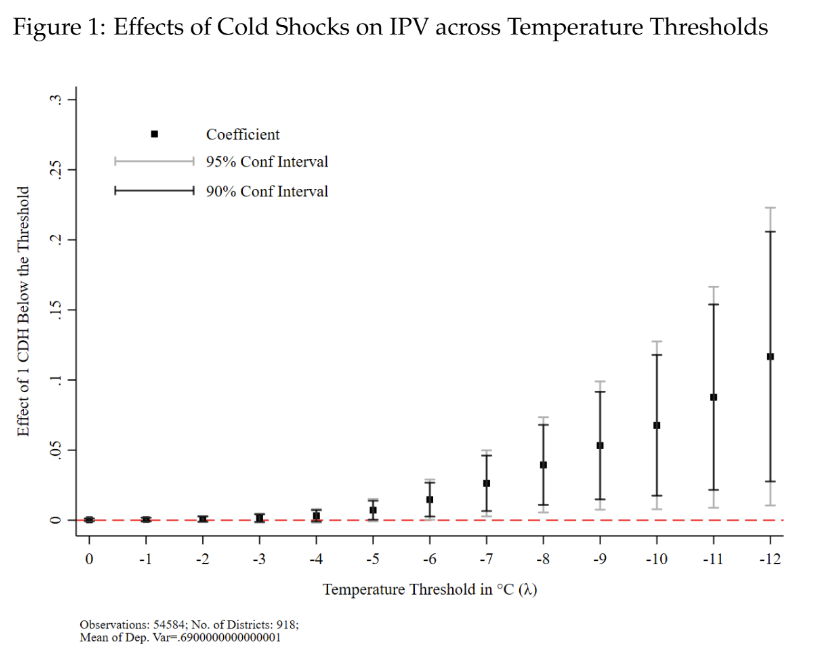
Violence against women – in particular, Intimate Partner Violence (IPV) – is a health concern for women across the world. We study the effect of cold exposure on IPV among Peruvian women. Using a dataset that matches women to weather exposure, we find that cold shocks increase IPV: 10 degree hours below -9 °C increases the probability of experiencing domestic violence by 0.5 percentage points. These effects are larger for more extreme temperature thresholds. We provide evidence that cold influences IPV through two main channels. First, extreme cold reduces income. Second, extreme cold limits time spent outside of the household, potentially increasing exposure of women to violent partners. To our knowledge, we are the first to measure relative significance of these two channels by using variation in cold timing to distinguish shocks that affect IPV through changes in income from those that act through time spent indoors. We find that the effect of cold on IPV is mostly driven by low temperatures that occur during the agricultural growing season, when income is most affected; 10 degree hours below -9°C during the growing season increases the probability of experiencing IPV by 1.6 percentage points. In contrast, we find that cold exposure outside of the growing season has no statistically significant effect on IPV.
Working Papers

Flood labor thumbnail

Labor Market Impacts of Flooding in the United States

with Jude Bayham, Christopher Goemans, Dale Manning, Diellza Muriqi, and Jordan Suter
Presented at: 2025 AERE Summer Conference; 2025 WEAI-AERE Conference; 2025 AAEA Annual Conference; 2026 AMS Annual Conference; 7th World Congress of Environmental and Resource Economists, Lisbon, Portugal.
Read Abstract

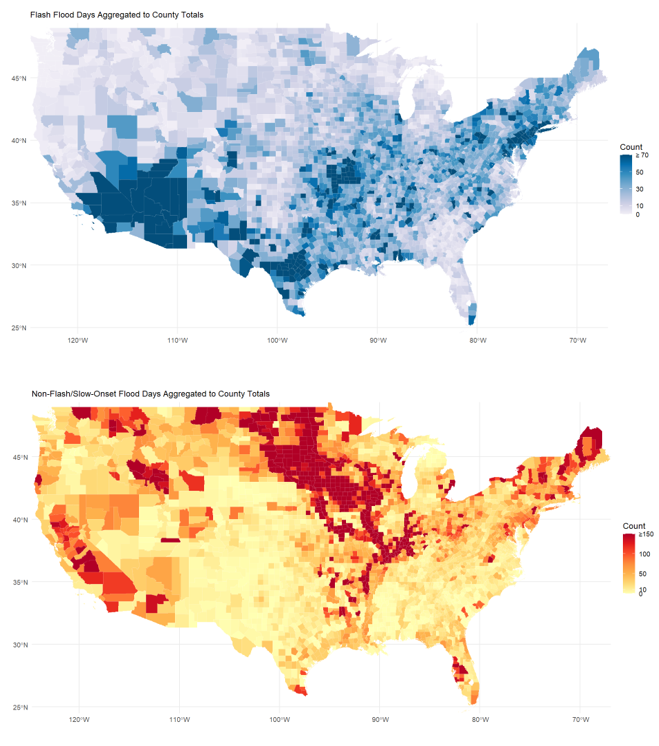
This study investigates the labor market consequences of floods -- historically among the most lethal and expensive natural disasters in the United States. Using quarterly, county-level employment and wage data spanning 1996-2023, our empirical approach distinguishes between flash floods and floods with gradual, slower onset patterns (non-flash floods). The empirical results show that an additional day of flash floods in a quarter reduces county-level employment and wages by 0.13% and 0.15% respectively. We find that total wages diminished by an average of $6.2 billion per year (in 2023 USD) between 1996 and 2023 as a result of flash and non-flash floods. Sectoral analyses show that wage impacts occur in both goods-producing and service sectors while goods-producing sectors drive employment effects. Heterogeneous effects reveal that economically vulnerable counties experience larger negative impacts from both flood types and that both coastal and inland counties face negative economic disruptions. Taken together, the sub-annual analysis uncovers labor market disruptions that are masked in annual aggregates, advancing understanding of flood impacts and informing the design of policies to build resilience against shocks.

PRD thumbnail

Can Covariate Shocks Affect Perceived Relative Deprivation? Evidence using Excess Rainfall Shocks in Peru

Judhajit Chakraborty
Blog: Economics That Really Matters · Presented at: 2026 Ahmedabad University, 2026 IIM Calcutta, 2024 DARE Seminar (CSU); 2024 SEEDS (Georgia Tech); Midwest Intl. Dev. 2024 (UChicago); Seminario MAP, Peru (Online); PacDev 2024 (Stanford King Center); AAEA 2023; Dev Lunch 2023 (MSU)
Read Abstract

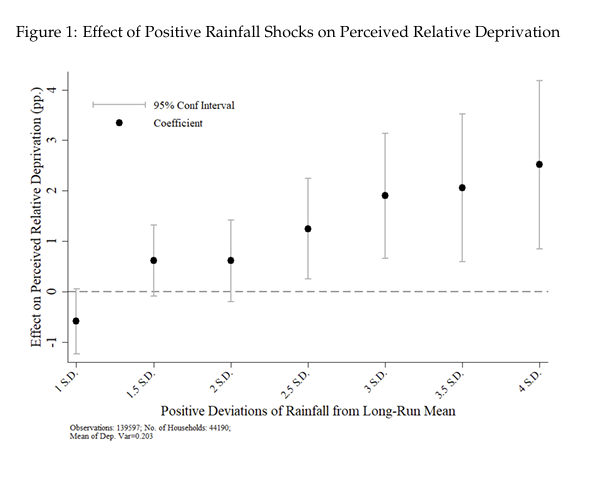
Perceptions of relative deprivation affect a range of economic and behavioral outcomes, such as support for redistribution, political attitudes, and risky behavior. There is scarce evidence regarding how covariate shocks that affect entire communities shape such perceptions. Using nationally representative panel data from Peru, and exploiting within-household variation in exposure to excess rainfall shocks (a covariate shock), I examine how such shocks shape households’ perceptions of standard of living relative to others in their locality – a measure of perceived relative deprivation. I find that excess rainfall shocks increase households’ perception of relative deprivation on average, as well as across both poor and non-poor households. The increase in perceived relative deprivation among poor households can be partially explained by the disproportionate economic losses that they experience following these shocks. However, this is not true for non-poor households who suffer no significant economic losses. Finally, households also systematically misperceive and underestimate neighbors’ welfare losses. This is a more salient explanation for the increased perceived relative deprivation among non-poor households following a shock. Suggestive evidence indicates participation in local neighborhood associations, which provide access to heterogeneous networks, can weaken such misperceptions. Additionally, access to social protection programs, such as conditional cash transfers and in-kind food assistance, attenuates the effect of these shocks on perceived relative deprivation. The paper informs our understanding of why demand for redistribution may remain muted during episodes of rising inequality and poverty, and reveal the potential limitations of community-based poverty targeting methods during crisis periods.

Democracy thumbnail

Reject, Punish, or Withdraw? Cold and the Political Response of Highland Households in Peru

with Eduardo Nakasone and Leah Lakdawala
Read Abstract

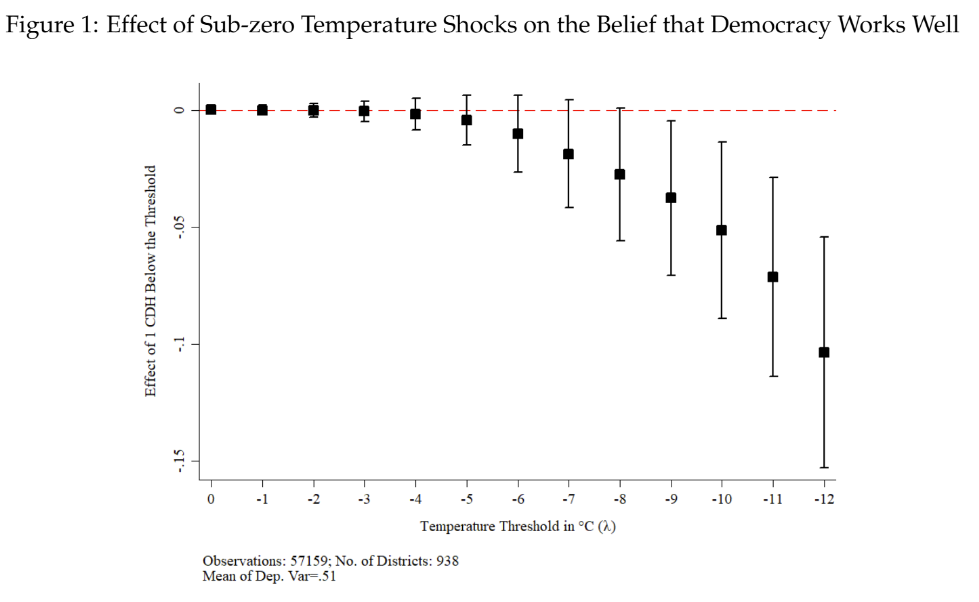
When a shock reveals that the state does not protect them, citizens may reject the political system, punish those in office, or withdraw. We ask which response prevails in the Peruvian highlands, using exposure to cold as the shock. We match twelve rounds of the national household survey to hourly temperatures at each household's location and identify the effects of cold from the variation in the timing of interviews within districts. Cold lowers farm revenue, kills livestock, and makes vulnerable household members more likely to fall ill and require medical attention. Households conclude that democracy delivers less: they become less likely to believe that democracy works well and that the rights it promises are respected, while support for democracy as a principle and confidence in specific institutions do not change. They withdraw rather than punish: absenteeism rises in presidential and municipal elections despite mandatory voting, but incumbent mayors are not punished; participation in community associations rises, and individual identity shifts from the state to indigenous groups. The erosion of support is concentrated where Peru's main cash transfer program reaches few of the poor, suggesting that social protection shields the relationship between citizens and democracy when extreme weather strikes.

Peru COVID thumbnail

The Electoral Consequences of Pandemic Mortality: Ideological Shifts in Peru’s Presidential Elections

with Eduardo Nakasone and Leah Lakdawala
Read Abstract

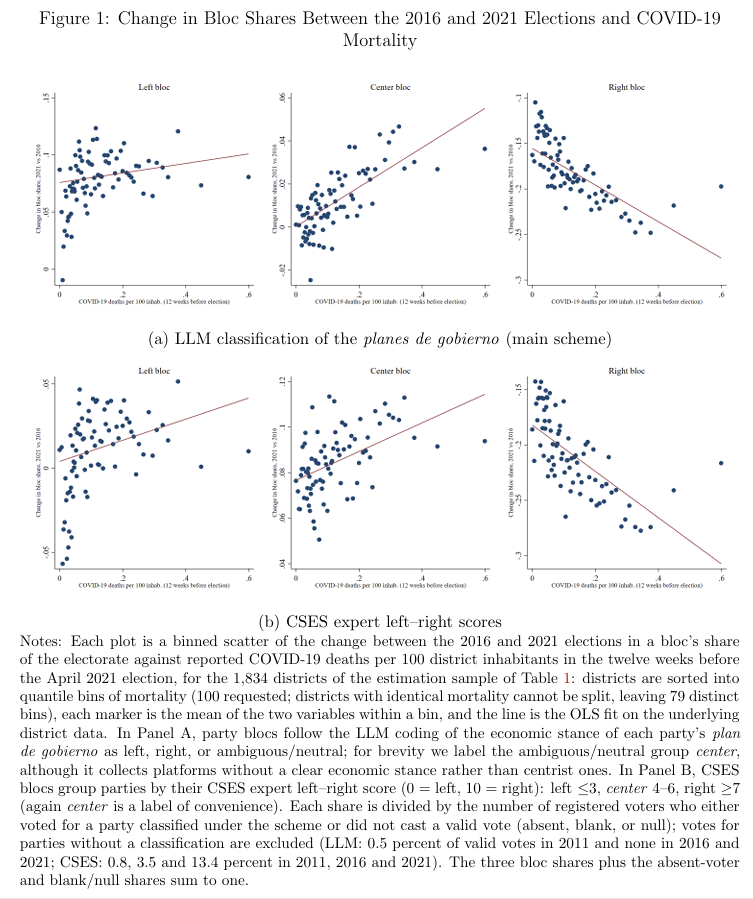
Using district-level data from Peruvian presidential elections, we examine how local exposure to COVID-19 mortality shaped voting in 2021. We decompose each district's electorate into votes for left, center, and right party blocs, classifying parties by the economic stance of their published platforms. Relative to their voting in earlier elections, districts with higher COVID-19 mortality in the months preceding the election moved away from parties of the market-oriented right and toward the left and center. Falsification tests reveal no evidence of differential pre-pandemic trends, and the decline of the right and rise of the left are robust to regional trends, alternative mortality measures, and alternative party classifications. Harder-hit districts experienced significant declines in household income and expenditure, and their residents were more likely to view Peru's income distribution as unfair, while turnout did not respond. The evidence is consistent with pandemic-induced economic hardship eroding support for parties defending the market status quo and raising demand for redistribution.

Work in Progress

Pre-Ph.D. Peer-Reviewed Publications

Continued Misery or a Change in Fortune? The Case of the Howrah Foundry Industry
Book Chapter in Industrialisation for Employment and Growth in India, Cambridge University Press (2021)

Deindustrialisation Thumbnail Has India Deindustrialised Prematurely? A Disaggregated Analysis
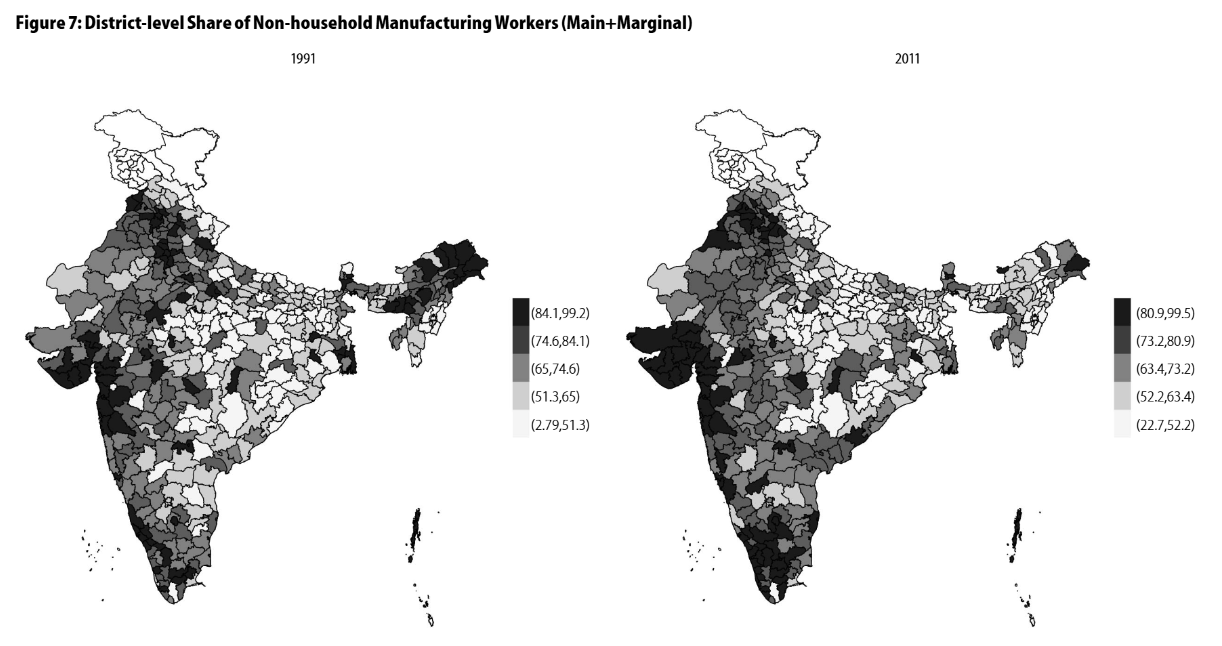
with R. Nagaraj - Economic and Political Weekly (2020)
Media coverage: Mint, Scroll.in

Land as Collateral Thumbnail Land as Collateral in India
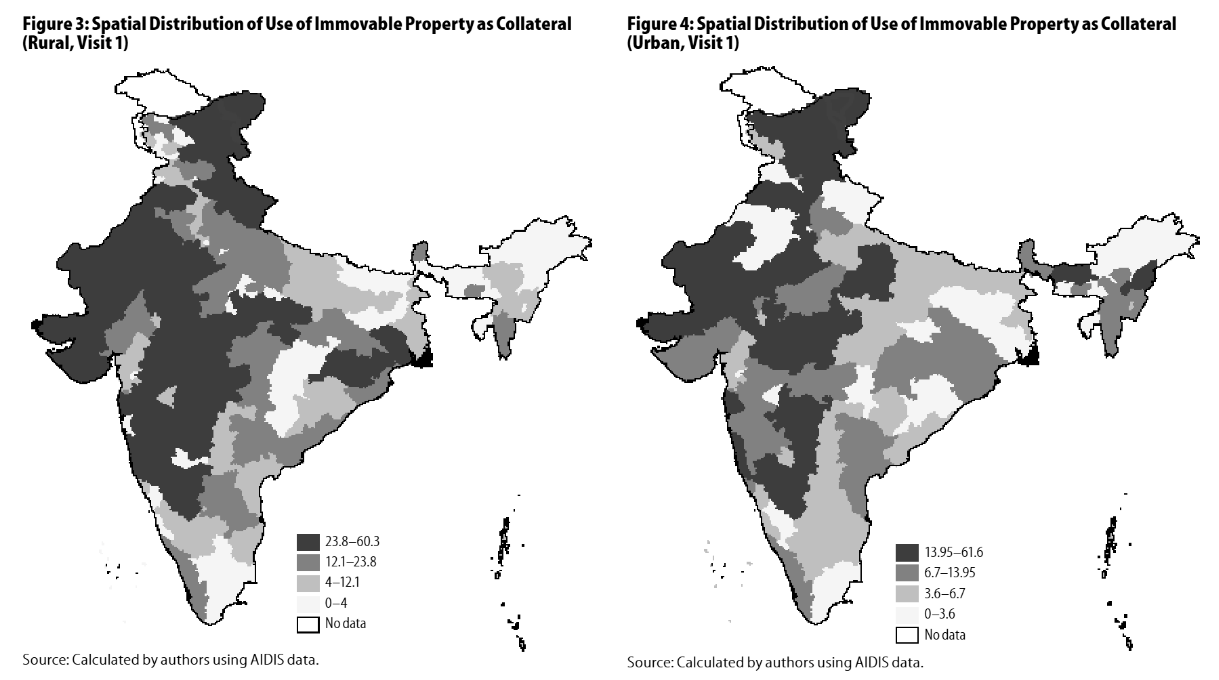
with Sudha Narayanan - Economic and Political Weekly (2019)
Media coverage: Mint

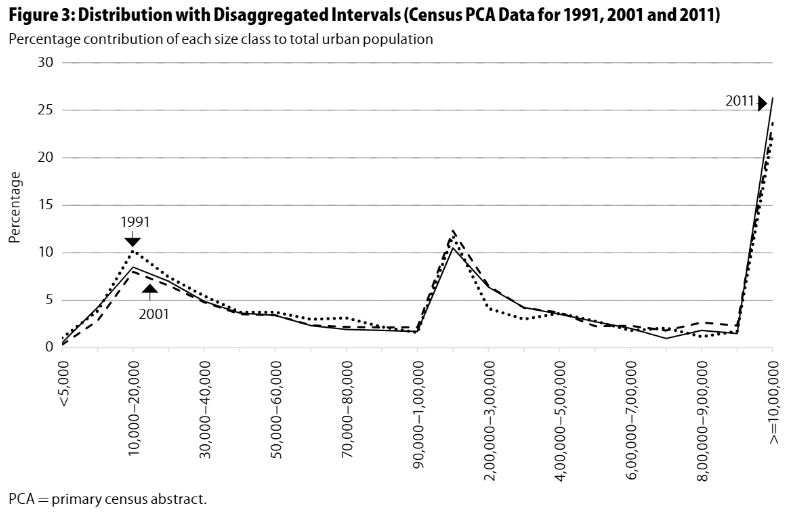
Urbanization Thumbnail An Unequal Process of Urbanization
Economic and Political Weekly (2017)


Teaching

Teaching evaluations: All courses


Contact

Colorado State University · Department of Agricultural & Resource Economics
judhajit.chakraborty@colostate.edu